Scars of Independence by Holger Hoock
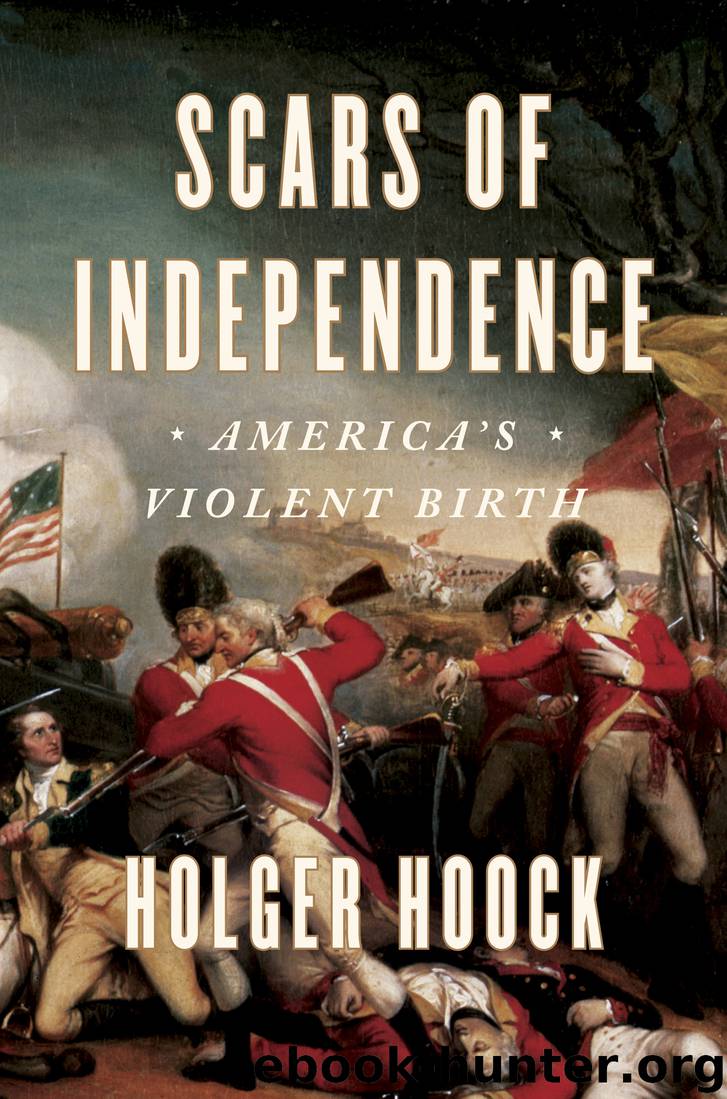
Author:Holger Hoock
Language: eng
Format: epub
Publisher: Crown/Archetype
Published: 2017-05-08T16:00:00+00:00
Mobilizing greater numbers of blacks, such as for the defense of Savannah, was part of a new British strategy that had been triggered by dramatic changes in the war’s international contexts. After France had entered the fight as an ally of the United States in 1778, Spain—even though it did not yet recognize American independence—declared war on Britain the following year, hoping to recapture former possessions like the Floridas, Jamaica, Gibraltar, and Minorca. What had started as a war in North America had expanded into a worldwide conflict. By 1779, British naval and military forces were confronting the Bourbon powers in Central America and the Caribbean, West Africa and India, as well as in Europe, where the Spanish were blockading Gibraltar and the French were preparing to invade the British Isles. From London’s perspective, the war against the thirteen rebellious American colonies was no longer the most important theater in Britain’s newly global struggle.5
In early 1778, the British government had briefly considered ending the war in North America altogether; a sense of duty towards the Loyalists weighed heavily in the decision to carry on. But it was clear that Britain would need to adjust its American strategy to fit its new geostrategic circumstances. The government thus executed a pivot to the Southern colonies that it had been contemplating since the winter of 1777–78. Holding the American South was still seen as vital to supplying Britain’s Caribbean sugar islands, the economic powerhouse of the Empire. But with regular British troops increasingly required to fight the Empire’s wars globally—by 1779, several regiments had already been redeployed from North America to the Caribbean, with others recalled to the British Isles—Britain would now need to rely on homegrown support. And the South held two large reservoirs of manpower to tap: white Loyalists, and blacks. Both of these groups would be key to the process of Americanizing the war. But their mobilization would also significantly alter the dynamics of the conflict.6
Much of the South, and especially the backcountry regions of North and South Carolina, had been in the grip of violence for almost two decades. Frontier militia conducted scorched-earth raids against the Cherokees. Western settlers clashed with eastern elites in North Carolina in the Regulator Wars. Rival ethnic and religious groups and families carried their feuds with them as they migrated. Such social and political friction played out against the constant backdrop of slavery—of white oppression and of slave resistance. The British invasion intensified these preexisting tensions in the South, such that it became “a society struggling to contain the savagery of war, sometimes succeeding and sometimes failing,” as the historian Wayne E. Lee puts it.7
By recruiting Southern blacks for both support and fighting roles, Clinton aimed to use whites’ fear of ferocious slave unrest for tactical advantage. But blacks were not just pawns in the conflict among Anglo-American whites: they were also independent actors in their own right. And for many, Clinton’s proclamation presented an opportunity. Only a minority of the half a million
Download
This site does not store any files on its server. We only index and link to content provided by other sites. Please contact the content providers to delete copyright contents if any and email us, we'll remove relevant links or contents immediately.
| Africa | Americas |
| Arctic & Antarctica | Asia |
| Australia & Oceania | Europe |
| Middle East | Russia |
| United States | World |
| Ancient Civilizations | Military |
| Historical Study & Educational Resources |
Cat's cradle by Kurt Vonnegut(15365)
Pimp by Iceberg Slim(14522)
4 3 2 1: A Novel by Paul Auster(12403)
Underground: A Human History of the Worlds Beneath Our Feet by Will Hunt(12101)
The Radium Girls by Kate Moore(12035)
Wiseguy by Nicholas Pileggi(5795)
The Fire Next Time by James Baldwin(5454)
Perfect Rhythm by Jae(5411)
American History Stories, Volume III (Yesterday's Classics) by Pratt Mara L(5312)
Paper Towns by Green John(5195)
Pale Blue Dot by Carl Sagan(5013)
A Higher Loyalty: Truth, Lies, and Leadership by James Comey(4966)
The Mayflower and the Pilgrims' New World by Nathaniel Philbrick(4508)
The Doomsday Machine by Daniel Ellsberg(4493)
Killers of the Flower Moon: The Osage Murders and the Birth of the FBI by David Grann(4451)
The Sympathizer by Viet Thanh Nguyen(4398)
Too Much and Not the Mood by Durga Chew-Bose(4353)
The Borden Murders by Sarah Miller(4330)
Sticky Fingers by Joe Hagan(4207)
